
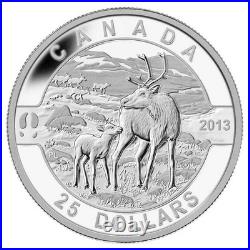


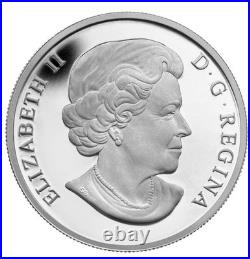
Check out these other great 2013 O Canada Series coins and sets! Beaver 1/10 Oz Gold. Polar Bear 1/10 Oz Gold. Multi-Coin Proof Sets in Solid Wood Display Cases. Canadian Icons Niagara Falls. Summer Fun at the Lake. RCMP Mountie – Royal Canadian Mounted Police. A masterwork of wildlife fine art, a mother caribou and her baby cubs (by artist Pierre Leduc) is intricately rendered in pure silver on this meticulously engraved, low mintage proof beauty! Celebrate Canada’s uniqueness with the Oh! Canada’s national identity is much like its majestic landscape: diverse, storied, and always fascinating! In the ever-changing world of Canadiana, a few concepts tend to reflect the nation’s natural assets and social and cultural institutions. Born of this complex background, these five Canadian animal icons are undeniable touchstones of the majestic land and its wildlife. These are the scenes that plumb the depths of Canada’s own pride in itself, while kindling the world’s love for the great nation that is Canada! Each one ounce wildlife proof depicts a mother with her babies! Collect these five pure silver proofs – then revisit your coins again and again to marvel at their cultural significance and detailed imagery! A Highly Detailed, Original Work of Art! This eighth release in the new O Canada series features a meticulously rendered design by Canadian artist Pierre Leduc: a female caribou (cow) and calf standing in the rugged terrain of the Canadian North. The mother stands on the right, her head turned toward her calf, her left eye peering at the viewer. Her tall antlers reach skyward atop her large head and strong neck. Beside her, the knobby-kneed calf peers shyly at its mother, waiting for her signal. The two stand in a grass-filled early summer valley. Behind them, their herd travels toward a river in the far distance. Rocky Mountain peaks rise to meet the far-off horizon. The design also features a stylized caribou hoof print to the left of the caribou, balancing the date of issue. The distinct design hallmark of the O Canada series has the central image set between two semi-circular banners (each laser polished to a gleaming, mirror-like finish) with the top band proudly proclaiming the legend Canada’s, and the denomination in the lower band. Ancient Spirit of the North: The Mighty Caribou. Known as caribou in North America and reindeer in Europe and Asia, is a member of the. In Canada, this family also includes moose, white-tailed deer, mule deer, and elk. Native to Canada, four subspecies of. Occupy tundra and boreal zones spanning from the West Coast to Newfoundland and from the USA-Canada border to Ellesmere Island. In total, Canada is home to about 2.4 million caribou, one of the world’s largest populations. This midsized ruminant lives primarily on nutrient-rich lichens in the winter, adding leaves and grasses to its diet as they become available in the warmer months. All caribou shovel their way to lichens through winter snows using specially adapted hooves. The hooves, whose rigidity changes with the seasons to give the animal greater grip on ice, rock, or boggy land, also grow much longer in winter to give the caribou greater traction on snow. The two dewclaws at the back of each hoof help to improve the caribou’s weight distribution and balance in any terrain. To escape their main predator, the grey wolf, caribou can run at speeds of up to 80 kilometers per hour, and are fast, strong swimmers. All caribou have noses with special adaptations that increase the surface area of the nostrils so that they can heat the frozen Arctic air as they inhale, before it reaches their lungs. The adaptation is believed to result from the need to visually distinguish objects in an environment which offers little visual contrast in the normal light range. Caribou are unique among. In that both sexes grow antlers. Though the males’ antlers are typically larger, giving them dominance through the summer months and autumn mating season, pregnant females retain their antlers long after the males have shed theirs in late autumn, thereby becoming dominant over the herd through the long winter months until they return to their calving grounds and give birth in May and June. Caribou are exceptional travelers, covering more ground in their migrations than any other land animal. Some of Canada’s caribou populations travel 5,000 kilometers each year. They migrate together in enormous herds; in spring, these groups can number 500,000 and are an amazing sight to behold. The Royal Canadian Mint refines the purest silver in the world. The RCM is also the only mint in the world to issue commemorative coins in a. This silver proof coin is 99.99% pure! A meticulously detailed and finely engraved detail of a mother Caribou and her young calf. The artistry is so subtle and intricate that the individual hairs on the caribous’ fur coats can be clearly distinguished under a loupe. The traditional-style engraving has produced a magnificent work of beauty. The date and denomination are also indicated. Her Majesty, Queen Elizabeth II, in profile facing right. This portrait, the fourth effigy of the queen to appear on Canadian Coinage, was executed by the artist Susanna Blunt. The legend ELIZABETH II D. REGINA (“Elizabeth II, Queen by the Grace of God”) also appears. The coin is encapsulated inside a burgundy leatherette, clamshell-style presentation case, lined with black velvet and protected by a black outer box. An individually-numbered certificate of authenticity is included. 9999 Fine (Pure) Silver. Canada’s national identity is much like its majestic landscape: diverse, storied, and sometimes elusive. In the ever-changing tectonics of Canadian culture, identifiers tend to reflect the nation’s multicultural nature and its geography, fauna and flora, and social and political institutions. Born of this complex background, Canadian icons are distinct because they carry meaning for all Canadians, regardless of where we live or how we came to be here. These are the images that plumb the depths of Canadian pride and kindle Canadians’ love for their home. Known as caribou in North America and reindeer in Eurasia, is a member of the. Occupy tundra and boreal zones spanning from the West Coast to Newfoundland and from the USA-Canada border to Ellesmere Island: the endangered Woodland Caribou. Of the northern boreal region; the Barren-ground Caribou. , which lives on the tundra north of the Woodland Caribou range; the small Peary Caribou. Of the Arctic; and the Porcupine Caribou. Of Canada’s northern territories. To escape their main predator, the grey wolf, caribou can run at speeds of up to 80 kilometres per hour, and are fast, strong swimmers. Each caribou subspecies bears important adaptations in size, musculature, and other physical traits that make it exceptionally well suited to its habitat. The smaller subspecies of the tundra are stouter, their shortened, fur-covered features protected from harsh Arctic winds. Fur colour also varies widely among caribou, depending on subspecies, season, and geographical location. Generally, the caribou’s colouring ranges from off-white to dark brown. Caribou are exceptional travellers, covering more ground in their migrations than any other land animal. Some of Canada’s caribou populations travel 5,000 kilometres each year. For Canadians, the caribou embodies the tale of this nation’s ageless landscape. In the caribou, we behold a vast migratory journey through space and time. We relate to its resilience, its ability, across the massive span of millennia and kilometres, to nourish itself and thrive in harsh, remote conditions. It teaches us the lessons of survival in this land: the benefits of slow, steady progress borne of tireless effort; the safety of the herd against predators large and small; and our intrinsic interconnection with the world we inhabit. It is no surprise that this unique animal is a Canadian icon, celebrated since 1937 on Canada’s 25-cent circulation coin, official animal of Newfoundland and Labrador, and shield-bearer of the Nunavut coat of arms.