
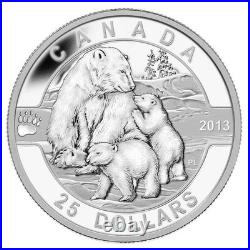

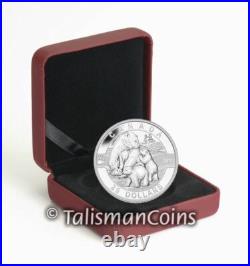
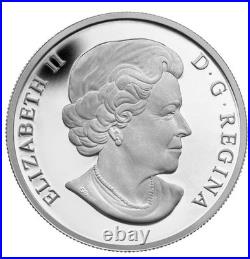
Check out these other great 2013 O Canada Series coins and sets! Beaver 1/10 Oz Gold. Polar Bear 1/10 Oz Gold. Multi-Coin Proof Sets in Solid Wood Display Cases. Canadian Icons Niagara Falls. Summer Fun at the Lake. RCMP Mountie – Royal Canadian Mounted Police. A masterwork of wildlife fine art, a mother polar bear and her baby cubs (by artist Pierre Leduc) is intricately rendered in pure silver on this meticulously engraved, low mintage proof beauty! Celebrate Canada’s uniqueness with the Oh! Canada’s national identity is much like its majestic landscape: diverse, storied, and always fascinating! In the ever-changing world of Canadiana, a few concepts tend to reflect the nation’s natural assets and social and cultural institutions. Born of this complex background, these five Canadian animal icons are undeniable touchstones of the majestic land and its wildlife. These are the scenes that plumb the depths of Canada’s own pride in itself, while kindling the world’s love for the great nation that is Canada! Each one ounce wildlife proof depicts a mother with her babies! Collect these five pure silver proofs – then revisit your coins again and again to marvel at their cultural significance and detailed imagery! A Highly Detailed, Original Work of Art! This fourth release in the new O Canada series features a meticulously rendered design by Canadian artist Pierre Leduc: a portrait of a mother polar bear playing with her two young cubs on a frozen Arctic hillside. The massive mother sits patiently on her hindquarters in a snowdrift as one cavorting cub, standing on its hind legs, paws at her left arm. She turns to her cub, the two almost nose-to-nose, as though in good humor. In front of her, the other cub, viewed from its left side, stands on all fours surveying its frozen home, perhaps readying itself for a game of ice sliding. Above the bears and to the right side of the image rises a large snowdrift topped by two snow-covered trees. The design also features a stylized polar bear paw print to the left of the bear, balancing the date of issue. The distinct design hallmark of the O Canada series has the central image set between two semi-circular banners (each laser polished to a gleaming, mirror-like finish) with the top band proudly proclaiming the legend “Canada”, and the denomination in the lower band. The Quintessentially Canadian and American! For many North Americans, the profile of a polar bear. Is as recognizably Canadian as the shape of a maple leaf or the silhouette of a Canada goose. Canada’s polar bears comprise more than half of the entire world’s population, since they live primarily in the coastal regions of the Arctic, depending upon sea ice to hunt the ringed seal. The polar bear’s adaptations to its carnivorous lifestyle in the frozen north include a thick layer of subcutaneous fat, dense water-repellent fur the color of snow, fur on the bottoms of its paws for traction and warmth, sharp claws, and an elongated body and huge forepaws that make polar bears great swimmers. The Royal Canadian Mint refines the purest silver in the world. The RCM is also the only mint in the world to issue commemorative coins in a. This silver proof coin is 99.99% pure! A meticulously detailed and finely engraved detail of a mother polar bear and her two young or baby cubs. The artistry is so subtle and intricate that the individual hairs on the bears’ fur coats can be clearly distinguished under a loupe. The traditional-style engraving has produced a magnificent work of beauty. The date and denomination are also indicated. Her Majesty, Queen Elizabeth II, in profile facing right. This portrait, the fourth effigy of the queen to appear on Canadian Coinage, was executed by the artist Susanna Blunt. The legend ELIZABETH II D. REGINA (“Elizabeth II, Queen by the Grace of God”) also appears. The coin is encapsulated inside a burgundy leatherette, clamshell-style presentation case, lined with black velvet and protected by a black outer box. An individually-numbered certificate of authenticity is included. 9999 Fine (Pure) Silver. The Largest Terrestrial Carnivore – Endangered. Is a bear native largely within the Arctic circle encompassing the Arctic Ocean, its surrounding seas and surrounding land masses. It is the world’s largest land carnivore and also the largest bear (together with the omnivorous Kodiak bear, which is approximately the same size). An adult male weighs between 770 and 1,500 pounds (350-680 kg), while an adult female is about half that size. Although it is closely related to the brown bear, the polar bear has evolved to occupy a narrow ecological niche, with many body characteristics adapted for cold temperatures, for moving across snow, ice, and open water, and for hunting the seals which make up most of its diet. Although most polar bears are born on land, they spend most of their time at sea (hence their scientific name meaning “maritime bear”) and can hunt consistently only from sea ice, so they spend much of the year on the frozen sea. As of 2008, the World Conservation Union (IUCN) reports that the global population of polar bears is only 20,000 to 25,000, and is declining. In 2006, the IUCN upgraded the polar bear from a species of least concern to a vulnerable species. It cited a “suspected population reduction of great than 30% within three generations (45 years)”, due primarily to global warming. The IUCN also cited a “potential risk of over-harvest” through legal and illegal hunting. A little good news – on 15 May 2008, the United States listed the polar bear as a threatened species under the Endangered Species Act and banned all importing of polar bear trophies. Importing products made from polar bears had been prohibited from 1972 to 1994 under the Marine Mammal Protection Act, and restricted between 1994 and 2008. Under those restrictions, permits from the United States Fish and Wildlife Service were required to import sport-hunted polar bear trophies taken in hunting expeditions in Canada. The permit process required that the bear be taken from an area with quotas based on sound management principles. Since 1994, more than 800 sport-hunted polar bear trophies have been imported into the U. Unfortunately, Canada has not followed suite with a hunting ban. The territory of Nunavut accounts for 80% of Canadian kills. In 2005, the government of Nunavut increased the quota from 400 to 518 bears, despite protests from some scientific groups. In two areas where harvest levels have been increased based on increased sightings, science-based studies have indicated declining populations, and a third area is considered data-deficient. The Government of the Northwest Territories maintain their own quota of 72-103 bears within the Inuvialuit communities of which some are set aside for sports hunters. Canada’s national identity is much like its majestic landscape: diverse, storied, and sometimes elusive. In the ever-changing tectonics of Canadian culture, identifiers tend to reflect the nation’s multicultural nature and its geography, fauna and flora, and social and political institutions. Born of this complex background, Canadian icons are distinct because they carry meaning for all Canadians, regardless of where we live or how we came to be here. These are the images that plumb the depths of Canadian pride and kindle Canadians’ love for their home. Polar Bear: King of the Arctic In the vast Canadian Arctic. Like its homeland, it is massive – males can weigh up to 800 kilograms and females are about 400 kilograms. Although polar bears inhabit Arctic coasts around the world, Canada hosts the largest population on earth: about 15,000 of the global total of approximately 25,000. Distinct for its creamy white colouring, the Polar Bear is well adapted for its home Perhaps the Polar Bear’s most important adaptation is its ability to slow its metabolism to survive lean times: its body will automatically go into energy conservation mode if the bear has not eaten for about a week. Ironically, this massive apex predator is born tiny and helpless. Weighing less than a kilogram with very fine hair, Polar Bear cubs-usually born in sets of two-enter the world in the relative warmth and safety of the maternal den. Mother and cubs will wait there for several months until the cubs are strong enough to survive the cold. Beginning around March, the cubs accompany their mother on hunts for their food staple, the ringed seal. Their exceptional sense of smell is powerful enough to detect a seal’s breathing hole in the ice from a kilometer away. The cubs will stay with their mother until they are about two and a half years old, creating a three-year breeding cycle that helps to explain the slow growth of Polar Bear populations. A symbol of the power and vastness of Canada’s northern landscape, the polar bear is an iconic animal for Canadians. In a nation dominated by weather extremes, the Polar Bear’s ability to survive and thrive in the harshest climate reflects Canadians’ stalwart pragmatism and spirit of adventure.