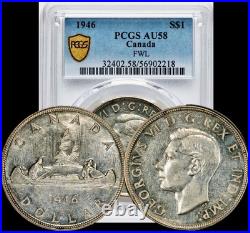
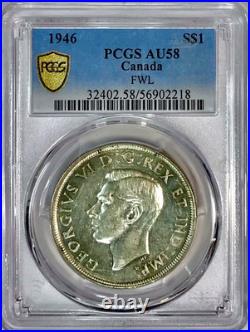
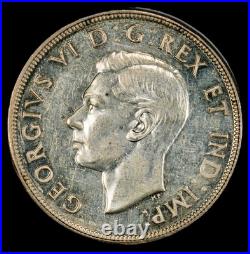
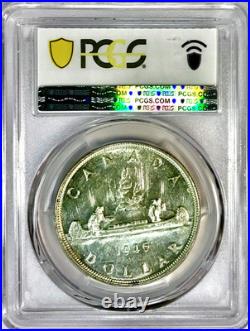
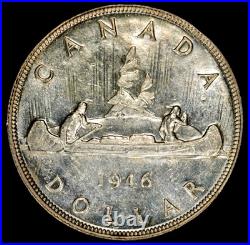
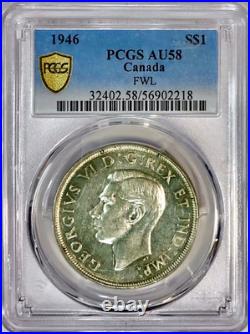
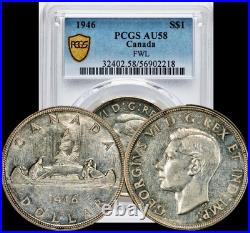
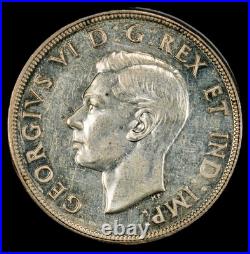
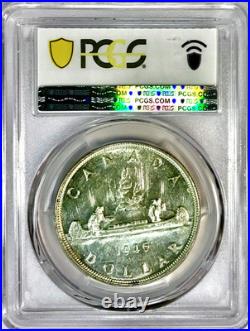
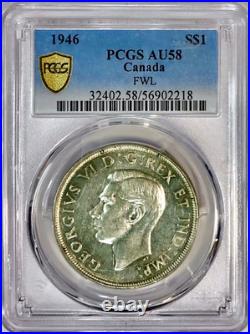
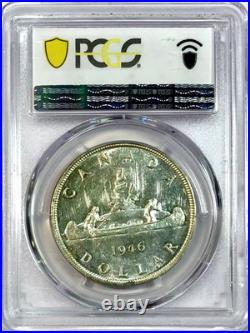
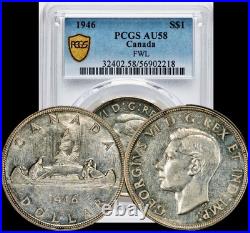
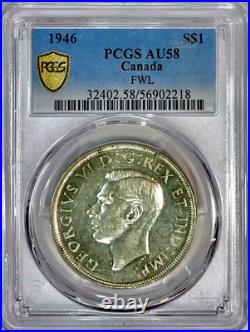
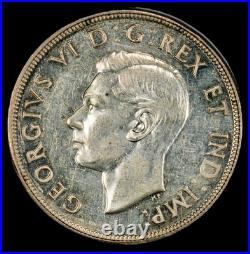
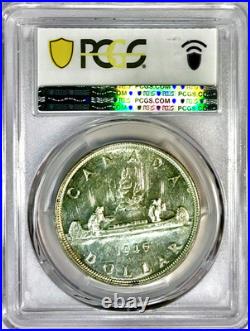
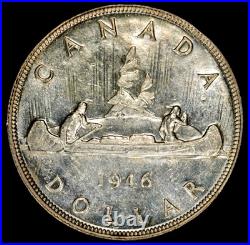
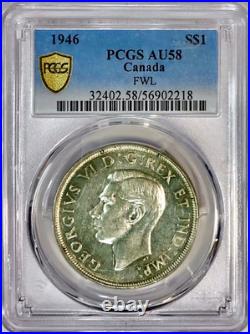
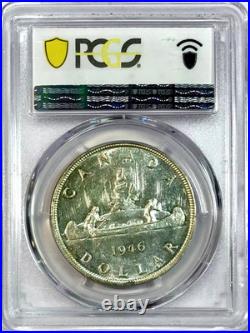
WE HAVE GREAT FEEDBACK. Now, here is the item that you came for. 1946 Canada George VI “Voyager” Silver Dollar PCGS AU58 FWL. KM37 Mintage 93,055. Please take a look at the photos. Please feel free to send us a message any time. ? Need to reach us after 6PM, no problem, we periodically check our messages throughout the night, and someone will get back to you. ????? . Please be sure to add our items to your watchlist so that you may receive exclusive offers and discounts. Special offers and discounts available to only those watching our item(s). It’s always our goal to provide five star service and we appreciate. We view your feedback as indication of the. We will always reciprocate for feedback. PLEASE CHECK OUT OUR OTHER LISTINGS. THANKS FOR L?? KING!
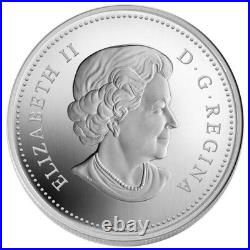
The spinning maple seeds of summer & a perfect crystal raindrop together on a simply stunning new Silver Maple Leaf proof! In combining the beauty and simplicity of the Swarovski crystal with its unique colorization process, the Mint has produced a marriage made in heaven – and the first Canadian coin of its kind! Here we find a solitary maple leaf, caught at the precise moment when a lone raindrop, tugged by gravity, begins its descent to the forest floor. The maple is an endless source of beauty throughout the year. People most readily associate it with the breathtaking crimson and gold hues of autumn, but those with an observant eye will also recall the clusters of tiny flowers that burst forth with vibrant freshness every spring and early summer – and carpet roads and driveways with drifting yellows and greens as blossoms fall to the ground. As summer progresses, seeds will form where female flowers once were; these winged whirligigs, called “samaras”, rotate like tiny propellers as they drift to the ground or when playful hands toss them into the air. So powerful is the association between the maple leaf and Canada that you might be be surprised to learn that of the 115 species of maple trees in the world, only ten occur naturally in Canada! From the fresh new growth of spring to their ultimate expression of vibrant fall hues, the leaves of the maple enrich the Canadian landscape from coast to coast. In summer, they form a dense canopy that shields against the summer sun, as well as unexpected rain showers. When the clouds clear, the leaves shine with renewed vibrancy, their wet surfaces reflecting maximum light from the sun. But this moment of heightened beauty is short-lived. As each leaf bends under the weight of the moisture, water collects at its lowest point and begins to form a water droplet. The droplet is dynamic. It continues to grow until the leaf can no longer support its weight. The leaf curves forward, and for a fleeting moment a tear-shaped drop of water hangs between heaven and earth before falling to the ground – a tiny echo of the life-giving rain that passed a few moments earlier. This is the tenth (and lowest mintage) in the series of annual Color Silver Maple Leafs. Stunning in its artistry, beauty and simplicity, this new pure silver proof in the Color Silver Maple Leaf Series ups the ante with a few twists. These upgrades to this most popular of annual programs include: 1. The lowest mintage limit ever. (10,000) to date for a Color Silver Maple Leaf! Before the innovations of the past two year’s Crystal Raindrop Color Silver Maple Leafs, all the previous coins in the Color Silver Maple Leafs Series feature the specimen finish. In fact, this is only the 4th proof-finish SML ever (including the 1989 proof SML). A new, much higher denomination! A genuine Swarovski crystal! Not only is this only the second color SML in the series to feature a crystal, it’s also only the fourth Royal Canadian Mint coin ever to combine a crystal with color! Taken together, these upgrades create the most unique coin in the series – and a work of unparalleled gorgeousness! We believe that this coin presents an entry-level investment opportunity in a relatively low-priced proof. A quick sell out was expected and occurred as predicted. For more information about Swarovski crystals of Austria, please see the presentation at the end of this article. The Royal Canadian Mint leads the world with its proprietary colorization technology, in which the color is actually sealed on the coin. The intricate detail, smooth gradients, and extreme precision of the technology create a stunning look on each coin. The Royal Canadian Mint refines the purest silver in the world. This one ounce silver coin is 99.99% pure! A beautiful, full-color image of a sprig of vibrantly hued maple leaves, with seed cluster attached, and yielding to the weight of a single raindrop, represented by a genuine Swarovski crystal. The date and denomination are both indicated. A cameo proof portrait of Her Majesty, Queen Elizabeth II, in profile facing right. This portrait, the fourth effigy of the queen to appear on Canadian coinage, was executed by the artist Susanna Blunt. The legend ELIZABETH II D. REGINA (“Elizabeth II, Queen by the Grace of God”) and mint mark also appear. The coin is encapsulated inside a burgundy leatherette, clamshell-style presentation case, lined with black velvet and protected by a black outer box. An individually-numbered certificate of authenticity is included. Proof with Color and Swarovski Crystal. 9999 Fine (Pure) Silver. Swarovski is the luxury brand name for the range of precision-cut crystal glass products produced by the privately-owned company Swarovski AG of Feldmeilen, Austria near Zürich. Swarovski crystal was born when a Bohemian, Daniel Swarovski, invented >an automatic cutting machine in 1892. In 1895 the Swarovski company was founded when he established a crystal cutting factory in Wattens (near Innsbruck, Tyrol, Austria). Here he could take advantage of local hydroelectricity for the energy-intensive grinding processes he had patented. Swarovski crystal contains approximately 32% lead to maximize refraction. The Swarovski Crystal firm produces a wide range range of products, but is world-renowned for the incredible quality and brilliance of its crystal jewelry. In order to create a crystal that allows light to refract in a rainbow spectrum, Swarovski coats some of its crystals with special metallic chemical coatings. For example, Aurora Borealis, or “AB”, is one of the most popular coatings, and gives the surface a rainbow oil slick appearance. Recent developments include the 2004 release of a new, patented cut, Xilion, designed to optimize the brilliance of roses (crystal components with flat backs) and chatons (diamond-cut crystals).
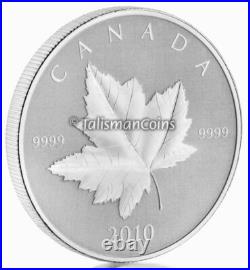
Make this beautiful, FIRST EVER extra thick Piedfort Pure Silver Maple Leaf with reverse proof finish a part of your holdings today! When Canada introduced the first Silver Maple Leaf in 1988, who knew that this would become the most popular and collected series of Canadian coins in history? Now, over twenty years later, the mint is again making history with this stunning, extra thick pure silver gem! First ever piedfort Silver Maple Leaf. Features a reverse proof finish and an extremely low mintage, creating a investment opportunity for the savvy collector! If the sheer, simple beauty of this coin and the low price aren’t enough reason to add one (or more) of these to your collection, here’s a few more. Piedfort Silver Maple Leaf to date! Total worldwide mintage is only 9,000 (of which only 6,000 will be available singly, outside the Gold & Silver Maple Leaf Piedfort 2-Coin Set)! Every Silver Maple Leaf collector needs this coin! Given its unique status and high profile, this will likely become a key to the SML series. Here’s a few interesting facts about the new Piedfort Silver Maple Leaf. A brand-new, naturalistic single maple leaf design. 9999 fine, the purest silver refined and minted anywhere in the world! A maple leaf that is thicker than any other silver maple ever issued! Unique, reverse proof finish. Encapsulation and full numismatic packaging, with individually numbered certificate. Here’s one more tidbit to mull over when considering how many of these simple and elegant beauties to add to your holdings. This is the lowest-mintage special edition Silver Maple Leaf ever issued! What is a Piedfort? Hard to find and popular with collectors for more than a century, piedforts are highly sought after. We get asked all the time, What is a piedfort? ” There are two different, but related, stories of the origin of the word “piedfort. The first says that it literally means “strong foot” in French from. The second says this word was appropriated by the mint centuries ago to mean “heavy measure” or “heavy weight”. In both cases, the sense of serious heft to the coin is obvious. Often the word “piedfort” is translated as “double-thick”, but this is neither a literal translation nor a precisely accurate definition. Numismatically speaking, any coin that is 50% or more thicker than a standard version qualifies as a piedfort, although some piedforts are, indeed, twice as thick as normal. Finally, the age-old question, How is the word pronounced? ” Coming from French, it is not pronounced as it is spelled; that is, don’t say, “pide – fort. Rather, “pee – ay – four” (three syllables) is a good approximation. Here is the exception. Remember, every SML collector needs this coin, so it’s a sure bet that there won’t be enough to go around and that the Mint will sell out much sooner than later. Because of the exceptionally low mintage limit and uniqueness within the SML series, we believe that this coin will become a key to the entire series. Don’t delay on this one, or you will regret it later! The Royal Canadian Mint refines the purest silver in the world. This one ounce silver coin is 99.99% pure! The devices (raised areas of design and lettering) are mirrored, and the fields (low areas or background) are white cameo frosted. A new, realistically-rendered image of the single maple leaf. The legend 9999 guarantees the purity, while the date is also indicated. Her Majesty, Queen Elizabeth II, in profile facing right. This portrait, the fourth effigy of the queen to appear on Canadian coinage, was executed by the artist Susanna Blunt. The legend ELIZABETH II D. REGINA (“Elizabeth II, Queen by the Grace of God”) also appears. Each silver maple leaf is encapsulated inside an elegant, burgundy leatherette, clamshell-style presentation case lined with black velvet and protected by a black outer box. An individually-numbered certificate of authenticity is included. 9,000 (only 6,000 singly). 9999 Fine (Pure) Silver. Royal Canadian Mint engravers.
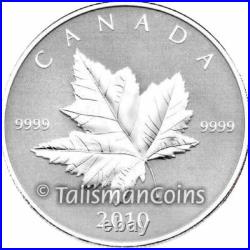
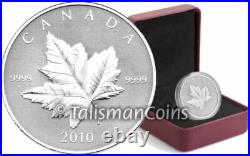
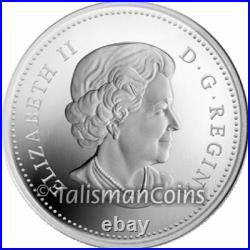
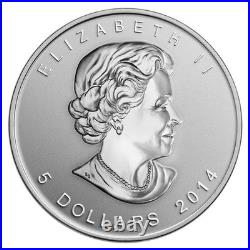
The classic, single maple leaf design, a national symbol of Canada, adorns this much-desired, pure silver beauty! The reverse proof finish and limited mintage make this SML an instant classic. What could be more beautiful than a single, perfect maple leaf? Hold it in your hand and gaze at this marvel of nature – so deceptively simple, yet so compelling. Along with the Beaver and the Mountie, the Maple Leaf is considered one of the three iconic emblems of Canada – so definitive, in fact, that in 1965 the National Flag of Canada was changed to the red and white maple leaf flag we know today. Reverse Proof Finish & Limited Mintage! Replacing the standard specimen bullion finish of basic >Silver Maple Leaf coins, the reverse proof finish on this. Special Edition Silver Maple. Really sets it apart – as does the limited mintage of only 20,000. Each is encapsulated and presented in a handsome, burgundy display box. The pristine condition, novel finish, mintage limit and presentation case all make this Silver Maple an instant classic, certain to be sought after by generations of future collectors the silver maple leaf. The most collected of all Canadian coins, eh? Now you can capture this very same beauty on one of the best-known and most widely collected precious metal coins in the world, the Silver Maple Leaf. First minted in 1988, Canada’s own SML is the purest silver coin ever struck, and has the highest face value, a full five dollars, as well! The Canada Silver Maple Leaf is the most collected of all Canadian coins! 4th effigy by Susanna Blunt Technology Note The Royal Canadian Mint refines the purest silver in the world. This one troy ounce silver coin is 99.99% pure! A highly-detailed depiction of a single maple leaf. The legends FINE SILVER 1 OZ and 9999 guarantee the weight and purity. Her Majesty, Queen Elizabeth II, in profile facing right. This portrait, the fourth effigy of the queen to appear on Canadian coinage, was executed by the artist Susanna Blunt. The date, denomination and the legend ELIZABETH II also appear. Each silver maple leaf is encapsulated inside a burgundy leatherette, clamshell-style presentation case, lined with black velvet, protected by a black outer sleeve. An individually-numbered certificate of authenticity is included. 9999 Fine (Pure) Silver.
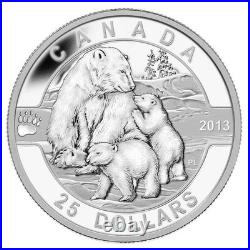
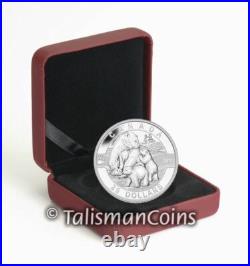
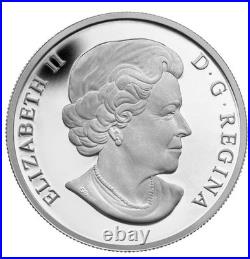
Check out these other great 2013 O Canada Series coins and sets! Beaver 1/10 Oz Gold. Polar Bear 1/10 Oz Gold. Multi-Coin Proof Sets in Solid Wood Display Cases. Canadian Icons Niagara Falls. Summer Fun at the Lake. RCMP Mountie – Royal Canadian Mounted Police. A masterwork of wildlife fine art, a mother polar bear and her baby cubs (by artist Pierre Leduc) is intricately rendered in pure silver on this meticulously engraved, low mintage proof beauty! Celebrate Canada’s uniqueness with the Oh! Canada’s national identity is much like its majestic landscape: diverse, storied, and always fascinating! In the ever-changing world of Canadiana, a few concepts tend to reflect the nation’s natural assets and social and cultural institutions. Born of this complex background, these five Canadian animal icons are undeniable touchstones of the majestic land and its wildlife. These are the scenes that plumb the depths of Canada’s own pride in itself, while kindling the world’s love for the great nation that is Canada! Each one ounce wildlife proof depicts a mother with her babies! Collect these five pure silver proofs – then revisit your coins again and again to marvel at their cultural significance and detailed imagery! A Highly Detailed, Original Work of Art! This fourth release in the new O Canada series features a meticulously rendered design by Canadian artist Pierre Leduc: a portrait of a mother polar bear playing with her two young cubs on a frozen Arctic hillside. The massive mother sits patiently on her hindquarters in a snowdrift as one cavorting cub, standing on its hind legs, paws at her left arm. She turns to her cub, the two almost nose-to-nose, as though in good humor. In front of her, the other cub, viewed from its left side, stands on all fours surveying its frozen home, perhaps readying itself for a game of ice sliding. Above the bears and to the right side of the image rises a large snowdrift topped by two snow-covered trees. The design also features a stylized polar bear paw print to the left of the bear, balancing the date of issue. The distinct design hallmark of the O Canada series has the central image set between two semi-circular banners (each laser polished to a gleaming, mirror-like finish) with the top band proudly proclaiming the legend “Canada”, and the denomination in the lower band. The Quintessentially Canadian and American! For many North Americans, the profile of a polar bear. Is as recognizably Canadian as the shape of a maple leaf or the silhouette of a Canada goose. Canada’s polar bears comprise more than half of the entire world’s population, since they live primarily in the coastal regions of the Arctic, depending upon sea ice to hunt the ringed seal. The polar bear’s adaptations to its carnivorous lifestyle in the frozen north include a thick layer of subcutaneous fat, dense water-repellent fur the color of snow, fur on the bottoms of its paws for traction and warmth, sharp claws, and an elongated body and huge forepaws that make polar bears great swimmers. The Royal Canadian Mint refines the purest silver in the world. The RCM is also the only mint in the world to issue commemorative coins in a. This silver proof coin is 99.99% pure! A meticulously detailed and finely engraved detail of a mother polar bear and her two young or baby cubs. The artistry is so subtle and intricate that the individual hairs on the bears’ fur coats can be clearly distinguished under a loupe. The traditional-style engraving has produced a magnificent work of beauty. The date and denomination are also indicated. Her Majesty, Queen Elizabeth II, in profile facing right. This portrait, the fourth effigy of the queen to appear on Canadian Coinage, was executed by the artist Susanna Blunt. The legend ELIZABETH II D. REGINA (“Elizabeth II, Queen by the Grace of God”) also appears. The coin is encapsulated inside a burgundy leatherette, clamshell-style presentation case, lined with black velvet and protected by a black outer box. An individually-numbered certificate of authenticity is included. 9999 Fine (Pure) Silver. The Largest Terrestrial Carnivore – Endangered. Is a bear native largely within the Arctic circle encompassing the Arctic Ocean, its surrounding seas and surrounding land masses. It is the world’s largest land carnivore and also the largest bear (together with the omnivorous Kodiak bear, which is approximately the same size). An adult male weighs between 770 and 1,500 pounds (350-680 kg), while an adult female is about half that size. Although it is closely related to the brown bear, the polar bear has evolved to occupy a narrow ecological niche, with many body characteristics adapted for cold temperatures, for moving across snow, ice, and open water, and for hunting the seals which make up most of its diet. Although most polar bears are born on land, they spend most of their time at sea (hence their scientific name meaning “maritime bear”) and can hunt consistently only from sea ice, so they spend much of the year on the frozen sea. As of 2008, the World Conservation Union (IUCN) reports that the global population of polar bears is only 20,000 to 25,000, and is declining. In 2006, the IUCN upgraded the polar bear from a species of least concern to a vulnerable species. It cited a “suspected population reduction of great than 30% within three generations (45 years)”, due primarily to global warming. The IUCN also cited a “potential risk of over-harvest” through legal and illegal hunting. A little good news – on 15 May 2008, the United States listed the polar bear as a threatened species under the Endangered Species Act and banned all importing of polar bear trophies. Importing products made from polar bears had been prohibited from 1972 to 1994 under the Marine Mammal Protection Act, and restricted between 1994 and 2008. Under those restrictions, permits from the United States Fish and Wildlife Service were required to import sport-hunted polar bear trophies taken in hunting expeditions in Canada. The permit process required that the bear be taken from an area with quotas based on sound management principles. Since 1994, more than 800 sport-hunted polar bear trophies have been imported into the U. Unfortunately, Canada has not followed suite with a hunting ban. The territory of Nunavut accounts for 80% of Canadian kills. In 2005, the government of Nunavut increased the quota from 400 to 518 bears, despite protests from some scientific groups. In two areas where harvest levels have been increased based on increased sightings, science-based studies have indicated declining populations, and a third area is considered data-deficient. The Government of the Northwest Territories maintain their own quota of 72-103 bears within the Inuvialuit communities of which some are set aside for sports hunters. Canada’s national identity is much like its majestic landscape: diverse, storied, and sometimes elusive. In the ever-changing tectonics of Canadian culture, identifiers tend to reflect the nation’s multicultural nature and its geography, fauna and flora, and social and political institutions. Born of this complex background, Canadian icons are distinct because they carry meaning for all Canadians, regardless of where we live or how we came to be here. These are the images that plumb the depths of Canadian pride and kindle Canadians’ love for their home. Polar Bear: King of the Arctic In the vast Canadian Arctic. Like its homeland, it is massive – males can weigh up to 800 kilograms and females are about 400 kilograms. Although polar bears inhabit Arctic coasts around the world, Canada hosts the largest population on earth: about 15,000 of the global total of approximately 25,000. Distinct for its creamy white colouring, the Polar Bear is well adapted for its home Perhaps the Polar Bear’s most important adaptation is its ability to slow its metabolism to survive lean times: its body will automatically go into energy conservation mode if the bear has not eaten for about a week. Ironically, this massive apex predator is born tiny and helpless. Weighing less than a kilogram with very fine hair, Polar Bear cubs-usually born in sets of two-enter the world in the relative warmth and safety of the maternal den. Mother and cubs will wait there for several months until the cubs are strong enough to survive the cold. Beginning around March, the cubs accompany their mother on hunts for their food staple, the ringed seal. Their exceptional sense of smell is powerful enough to detect a seal’s breathing hole in the ice from a kilometer away. The cubs will stay with their mother until they are about two and a half years old, creating a three-year breeding cycle that helps to explain the slow growth of Polar Bear populations. A symbol of the power and vastness of Canada’s northern landscape, the polar bear is an iconic animal for Canadians. In a nation dominated by weather extremes, the Polar Bear’s ability to survive and thrive in the harshest climate reflects Canadians’ stalwart pragmatism and spirit of adventure.
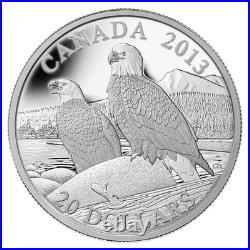
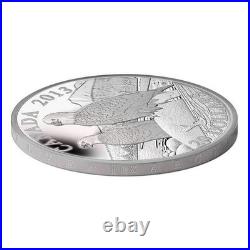
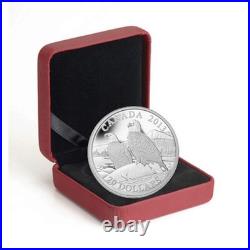
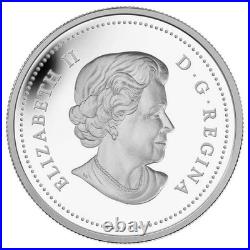
A masterwork of wildlife fine art, this moving portrait of an American Bald Eagle pair, Lifelong Mates, rendered in pure silver on this meticulously engraved, low mintage proof beauty – featuring edge lettering! Featuring realistic, naturalistic representations of some of Canada’s best-known animals! Designs recall those found on one of the most popular programs ever from the Royal Canadian Mint – the. Which will highlight the national bird of the United States of America from four different perspectives (please see below for more details on this program)! We’re pleased to present. A stunning group vignette of this noble bird. Frosted cameo proof in this new series features unique edge lettering (see image below)! Best of all is the extremely low mintage limit of 7,500. A Highly Detailed, Original Work of Art! The design by Canadian artist Claudio D’Angelo depicts two bald eagles perched on the rocky shore of a broad, fast-moving American river. Centered in the foreground, the eagles sit side-by-side. The one closest to the viewer is presented in three-quarter profile, its characteristic snowy head, sharp curved beak, dark, majestic wing and body feathers, and long talons rendered in exquisite dimensional detail. The eagle stares authoritatively into the eyes of viewer. Facing away from the viewer. Its sleek head and open beak are presented in profile, its broad neck and back finely rendered. At the very foreground in the lower portion of the image, we see the detritus of the vast and fast-moving river: a fallen tree, large boulders. In the background, a sandy point reaches into the heart of the waterway. The distant shore is lined with conifers, rising in the far background toward a skyline of towering mountain peaks. This coin also features unique edge lettering, with the words 1 OZ FINE SILVER 1 OZ ARGENT PURE engraved around the edge of the coin. The Magnificent Bald Eagle. The great Bald Eagle. Is a native North American bird of prey whose battle back from the brink of extinction in some areas in the 1970s, is a species success story. In Canada, salmon-rich British Columbia is the astonishing hunter’s stronghold! However, this magnificent bird breeds in all provinces and territories. Its populations are regularly monitored by wilderness authorities. Is not actually bald. The term bald may come from an outmoded usage meaning white, or from the term piebald, which means patchy. The bald eagle’s head and tail are covered in bright white feathers and the remainder of its body is dark brown. It has a sharp hooked beak and large feet tipped with long, razor-like talons and small spicules (spikes) that make it an exceptional hunter. Eagles are renowned for their amazing vision, which allows them to see up to seven times farther than humans. Their swiftness is also notable and they can reach especially high speeds when diving. They consume small mammals, snakes, other birds, and carrion. A bald eagle’s nesting spot of choice is a large tree near an isolated, well-stocked body of water. Their nests are among the largest in the world, spanning over ten feet (three meters) and weighing up to a ton, and host two eaglets per breeding cycle. Bald eagles are believed to mate for life. Their mating dance is a sight to behold, as prospective partners take turns trying to impress one another with complicated aerial maneuvers that include cartwheels, talon-locking, and more. Coastal eagles in more moderate climates tend to stay in the same territory year round; otherwise, eagles will migrate to coastal or southern wintering grounds. Population today seems to remain stable throughout most of its range. Is the national bird of the United States! We believe that this will be a very scarce issue, difficult to find in the aftermarket for years to come. Silver Proof (to say nothing of the previous in the series)! Finally, the edge lettering is a nice little bonus, too! The Royal Canadian Mint refines the purest silver in the world. The RCM is also the only mint in the world to issue commemorative coins in a. This one ounce silver coin is 99.99% pure! The artistry is so subtle and intricate that the individual feathers on the eagle can be clearly distinguished. The traditional-style engraving has produced a magnificent work of beauty. The date and denomination are also indicated. In profile facing right. This portrait, the fourth effigy of the queen to appear on Canadian coinage, was executed by the artist Susanna Blunt. The legend ELIZABETH II D. REGINA (“Elizabeth II, Queen by the Grace of God”) also appears. Unique to this series, the edge lettering legend 1 OZ FINE SILVER – 1 OZ ARGENT PUR guarantees the weight and purity of the metal content. The coin is encapsulated inside a burgundy leatherette, clamshell-style presentation case, lined with black velvet and protected by a full color outer box. An individually-numbered certificate of authenticity is included. 9999 Fine (Pure) Silver. Plain with Edge Lettering. A Match for Life. The amazing bald eagle. Is Canada’s largest bird of prey and the only eagle exclusive to North America. An apex predator with no natural enemies, the bald eagle has long been a potent symbol of vision, power, and stoicism. The adult boasts a wing span of more than 2 metres, a standing height of about 1 metre, and an average weight of up to 7 kilograms. Females are generally larger than males. The renowned raptor is noted for its distinctive dark-feathered body and white-feathered head, large golden eyes, bright yellow beak, and massive yellow claws armed with sharp, powerful talons. This long-lived bird can survive nearly 30 years in the wild and even longer in captivity. Nesting in tall trees near large bodies of water and well away from human habitation, bald eagles survive on a diet of fish, birds, invertebrates, and small mammals, but are opportunistic feeders who will also steal from other predators and eat carrion. The bald eagle does not reach reproductive maturity until its fifth year of life, at which time the eagle seeks a mate that will likely become its life partner. In some instances, mated adult eagles will seek a new partner if one of the pair leaves the region or dies, or if the pair have difficulty reproducing. The mating process begins with courtship, which is an amazing sight to behold for lucky onlookers. The courtship dance is a display of amazing partnered aerodynamics as the couple swoops, dives, spins, wheels, locks claws, chases and calls to one another in full flight high above the ground. Once mated, the pair seeks a nesting spot. Most bald eagles in Canada, concentrated particularly on the Pacific Coast, choose broad, tall conifers near the ocean or another large body of water. Those without access to trees will nest in cliffs or other elevated and isolated natural features. The region immediately surrounding the chosen nesting spot becomes the pair’s defensible hunting and breeding territory. Together, the couple tackles the considerable task of nest building. Bald eagle nests are massive structures of branch and twig averaging several metres in diameter and a metre deep. These nests become firmly established for this long-lived bird, which adds new material to the nest each year. Some eagle pairs will build more than one such nest within their territory, and will alternate their usage from year to year. The female will lay her one to three large eggs on a soft feather-lined divot in the centre of the structure. In Canada, most bald eagle populations are concentrated along the Pacific coast; however, stable smaller populations are also found across the prairie provinces, in Northern Ontario, on Cape Breton Island, and in Newfoundland. At-risk populations are found in southern Ontario and New Brunswick.
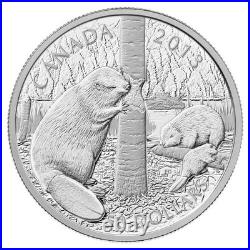
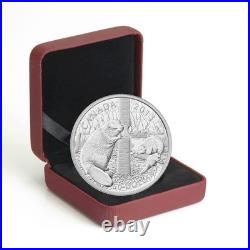
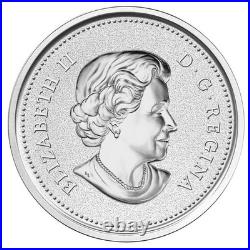
A masterwork of wildlife fine art, a beaver family by artist Emily Damstra, is intricately rendered in pure silver on this meticulously engraved, HUGE and low mintage 5 troy ounce pure silver proof beauty! Talisman Coins is proud to bring you the latest in the Royal Canadian Mint’s Canadian Wildlife Exploration Program, featuring realistic, naturalistic representations of some of Canada’s best-known animals! These outstanding wildlife designs recall those found on one of the most popular programs ever from the Royal Canadian Mint-the Wildlife Coin & Stamps Sets! Next up is the beaver, one of the official national symbols of Canada, representative of industrious nature! Following hot on the heels of the extremely successful introduction of the Robert Bateman Moose Series (with coins available in silver, gold and platinum), the beaver is certain to be as popular! Wildlife themes are always popular, and. This is the very first wildlife-themed five ounce pure silver proof in Canadian history! The original work of art depicts a beaver family, and the mintage limit is low-so very low, in fact (only 1,500 total), that we expected (and the Mint confirmed) a quick sell out! A Highly Detailed, Original Work of Art! The design by Canadian artist Emily Damstra features a portrait of a beaver family, its members immersed in the work of felling trees for their dam, lodge, and food cache. On the left side of the image, a large beaver stands upright, hard at work chewing the trunk of a birch tree with its sharp incisors. Wood shavings cover the ground beneath the beaver’s feet and around the base of the tree. The beaver itself stands on its back paws, counterbalanced by its large flat tail, holding the tree trunk with its dexterous front claws. Its small ears, eyes, and nose (which can seal themselves under water) are exquisitely rendered in exceptionally fine detail. On the right side of the image, behind and to the side of the upright beaver, another adult beaver and small kit (cub or young beaver) work on either side of a felled log, trimming away bark and preparing the log for use. On the extreme left of the image, the base of this felled tree is visible. The background of the image reveals a large pond backed by mountainous forest. The beavers’ food cache emerges from the center of the pond. Canada’s First Currency! “Busy as a beaver” refers to the hardworking and industrious nature of this furry critter. Along with the Mountie and the maple leaf, the beaver is considered one of the three iconic symbols of Canada. It’s not widely remembered today, but during the 1830s and’40s there was a fashion craze in Europe for beaver-fur hats. This provided the livelihood for the fur-trapping mountain men. Fortunately, the fashion died out in time for the beaver to be saved, allowing it to continue to dam streams and create new habitat for many other creatures. When trappers would bring their furs to the trading posts, something was needed to represent the value of the pelts. At first, everything from porcupine quills, ivory discs and bits of wood or bone were used – anything that that the trapper and merchant agreed upon. As the industry became more sophisticated, trade tokens began to appear. As the two parties went through the furs, tokens would be placed on the counter. Some trade tokens were square. Others featured the prize of the fur trade that also reigns as one of Canada’s earliest forms of currency – the beaver! To this day, the beaver is featured on the Canadian 5 cents (nickel) coin! In fact, the beaver is one of the official symbols of Canada. The Royal Canadian Mint refines the purest silver in the world. The RCM is also the only mint in the world to issue commemorative coins in a. This five ounce silver coin is 99.99% pure! A meticulously detailed and finely engraved detail of a beaver family, felling a tree. The artistry is so subtle and intricate that the individual hairs on the beaver’s fur coat can be clearly distinguished under a loupe. The traditional-style engraving has produced a magnificent work of beauty. The date and denomination are also indicated. Her Majesty, Queen Elizabeth II, in profile facing right. This portrait, the fourth effigy of the queen to appear on Canadian Coinage, was executed by the artist Susanna Blunt. The legend reads ELIZABETH II D. REGINA (“Elizabeth II, Queen by the Grace of God”). The coin is encapsulated inside a burgundy leatherette, clamshell-style presentation case, lined with black velvet and protected by a black cardboard sleeve. An individually-numbered certificate of authenticity is included. 9999 Fine (Pure) Silver. Canada’s National Animal: The Beaver. Along with the Canadian horse, the beaver is one of Canada’s two national animals. While the beaver became an official symbol of Canada in 1975, its use as a symbol of this land goes back to the country’s earliest roots. In fact, a beaver appears on the first coat of arms associated with the land now known as Canada, dating back to the early 1620s. Played a major role in Canada’s colonial history, becoming one of the primary motivators for the European explorers of the 17th century to forego their search for a passage to Asia and focus instead on the natural resources offered by the North American continent. With fur at its zenith in European fashions, beaver pelt hats became a product lucrative enough to feed settlement of the “new” continent by England and France. The fur trade has long-since ended, and efforts to protect this amazing animal began near the end of the 1800s, when beaver populations were in decline because of over hunting. Weighing up to 32 kilograms and measuring up to a metre in length, the beaver is the largest rodent in North America. Its sharp incisors fell about 200 trees annually, its paddle-like tail acts as a rudder in the water and a counterweight on land, and its adaptations to its semi-aquatic lifestyle are striking. Transparent eye membranes allow beavers to see as well underwater as on land, while specialized ears and nostrils completely close underwater. Its webbed hind feet make excellent swimming paddles and its web-free, sharply clawed forepaws are extremely dextrous, allowing this engineer of the animal kingdom to build its own bodies of water using dams, then construct an architecturally sound underwater lodge and mid-lake food cache, as well as canals where necessary. Its savvy forepaws are also helpful for careful fine-tuning, digging, and transporting its construction materials. Found throughout Canada from the 49th parallel to the Arctic Ocean, the beaver prefers water courses bordered by deciduous trees and shrubs. This 50-Dollar coin is certified to be 99.99% pure silver with a diameter of 65 millimetres and a metal weight of 5 ounces. The reverse design by Canadian artist Emily Damstra features a portrait of a beaver family, its members immersed in the work of felling trees for their dam, lodge, and food cache. The beaver itself stands on its back paws, counterbalanced by its large flat tail, holding the tree trunk with its dextrous front claws. Its small ears, eyes, and nose-which can seal themselves under water-are rendered in fine detail. On the right side of the image, behind and to the side of the upright beaver, another adult beaver and small kit work on either side of a felled log, trimming away bark and preparing the log for use. The beavers’ food cache emerges from the centre of the pond. The image occupies the entire reverse field and is engraved with the word “CANADA, ” the date “2013, ” and the face value of 50 DOLLARS. The obverse features the effigy of Her Majesty Queen Elizabeth II by Susanna Blunt.
WE HAVE GREAT FEEDBACK. Now, here is the item that you came for. 1946 Canada George VI “Voyager” Silver Dollar PCGS AU58 FWL. KM37 Mintage 93,055. Please take a look at the photos. Please feel free to send us a message any time. ? Need to reach us after 6PM, no problem, we periodically check our messages throughout the night, and someone will get back to you. ????? . Please be sure to add our items to your watchlist so that you may receive exclusive offers and discounts. Special offers and discounts available to only those watching our item(s). It’s always our goal to provide five star service and we appreciate. We view your feedback as indication of the. We will always reciprocate for feedback. PLEASE CHECK OUT OUR OTHER LISTINGS. THANKS FOR L?? KING!
WE HAVE GREAT FEEDBACK. Now, here is the item that you came for. 1946 Canada George VI “Voyager” Silver Dollar PCGS AU58 FWL. KM37 Mintage 93,055. Please take a look at the photos. Please feel free to send us a message any time. ? Need to reach us after 6PM, no problem, we periodically check our messages throughout the night, and someone will get back to you. ????? . Please be sure to add our items to your watchlist so that you may receive exclusive offers and discounts. Special offers and discounts available to only those watching our item(s). It’s always our goal to provide five star service and we appreciate. We view your feedback as indication of the. We will always reciprocate for feedback. PLEASE CHECK OUT OUR OTHER LISTINGS. THANKS FOR L?? KING!
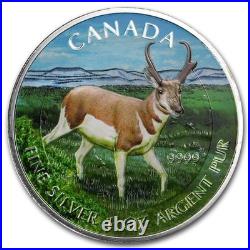
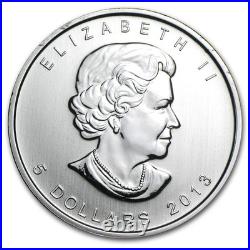
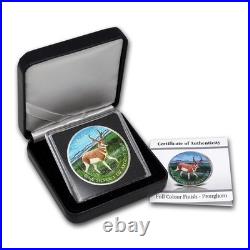
2013 Canada RCM Full Color Pronghorn Antelope Wildlife 1 oz Silver 0.9999 Coin. Series: Canadian Wildlife Series. Denomination: 5 Dollars (CAD). Composition: 1 troy oz of 99.99% fine silver. Mint Mark: Royal Canadian Mint (no mint mark). Certification: Certificate of Authenticity included. Official Royal Canadian Mint production Reverse design by Emily S. Damstra depicting a full-color Pronghorn Antelope in its native grassland Limited mintage of 5,000 coins Original finish: Brilliant Uncirculated (BU) Edge detailing: Reeded Weight: 31.103? G – Diameter: 38.00? Mm – Thickness: 3.15? Mm. RCM COINS PRESERVATION: Stored in original Mint protective sleeve & packaging Shielded from sunlight and moisture Never circulated – handled with care. Looking for specific items? I have many other coins that aren’t listed. Feel free to contact me at any time.